The Change Resilient Podcast Episode Two: Brett Hurt on Love and Abundance in an
AI-Powered Future
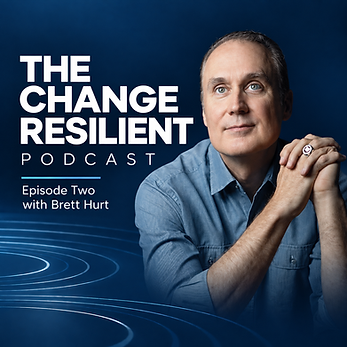
Brett Hurt is a serial software entrepreneur who has built seven successful companies. He founded Coremetrics which was acquired by IBM, co-founded and led Bazaarvoice through its IPO, and most recently co-founded and led data.world, which was acquired by ServiceNow in 2025. Brett is also an investor, a Henry Crown Fellow, and the author of The Entrepreneur’s Essentials.
His newest chapter is Love Conquers Fear—a USA Today best selling book, podcast, and broader mission exploring what happens as AI and other key technologies accelerate, with the goal of helping humanity make it to the Age of Abundance for All.
Listen on Spotify and wherever you enjoy your podcasts.
Links from show references below:
Love Conquers Fear (book, podcast, etc.)
The Lattice (Kindle book on Amazon)
Show transcript:
[00:00] Steve Semelsberger:
Hello, everybody! My guest today is Brett Hurt, a serial software entrepreneur who's built multiple successful companies here in Austin, Texas, my beloved town of the last 29 years. Brett founded Coremetrics, which was acquired by IBM, co-founded and led Bazaarvoice through its IPO, and most recently co-founded and led data.world, which was acquired by ServiceNow in 2025. Brett's an investor, a Henry Crown Fellow, and the author of The Entrepreneur's Essentials. His newest chapter is Love Conquers Fear, a USA Today best-selling book, a podcast, and really a broader mission that has a goal of helping humanity make it to the age of abundance for all. I'm fortunate to have known Brett for over 15 years, and to call him a dear friend of mine. I think you will love the conversation that we are about to have. Brett, welcome to the Change Resilient Podcast.
[00:54] Brett Hurt:
Thanks so much, brother. It is an honor to be on it with you, and thank you so, so much for pushing me, almost a year ago now. to read the Bhagavad Gita and read the Tao Te Ching, as translated by Stephen Mitchell, and most recently, on our most recent hike, to read the Gospels of Jesus, as translated by him. Really phenomenal reads, and as you know, your fingerprints are all over chapter 10 of my new book. Where I discuss the common route that we all come from, from the spiritual traditions, and the name of the book itself really comes from that common root, that we need to allow love to conquer our fear. And then we can help others do the work. And if we all do that work, guess what? We create heaven on earth. Or the Age of Abundance for All. Both are… both are the same thing.
[01:52] Steve Semelsberger:
The same… the same thing. You know, Brett, one of the things that strikes me from getting to know you, from listening to your book, from listening to your podcast. is you have this deep curiosity, and you have an incredible ability to be a pluralist, to be an integrator of different concepts. Have you always been a curious pluralist?
[02:16] Brett Hurt:
I would say yes. I haven't been as spiritual as I've become, but I've always had a lot of curiosity, I've always studied human behavior. I've always had, you know, just a tremendous, amount of love for humanity, even during the days where I was being picked on for being an early nerd. You know. working on the computer in days where very few people understood that. Now it's… now we're in this ultimate moment where revenge of the nerds has turned into the responsibility of the nerds. But… I have always been very, very curious about lots of things, and there's so much to be curious about, and this is the best time, actually, to be an eternally curious person, because you know, no matter what people think of AI, and it's kind of crazy that only 25% of Americans are positive on AI, and 80% of East Asians are positive on it, but it makes sense when you deconstruct how we're programmed, and why we have the fears we do. But forget about the term AI for a moment. Let's just say you're a curious person, and you met… A human being. who had all of humanity's spiritual text in their head, all of humanity's great philosophical text, everything ever written about science, all the detailed scientific papers, and you had that
[03:56] Brett Hurt:
across every single language in the world, but you could talk to it in any language you wanted to, even if it had ingested tons… if that human being had ingested tons and tons of Japanese text because they spoke every language, what would you ask them? That's the moment we're at right now, and I don't believe AI is conscious. This is not an argument for it being conscious. I think consciousness is a very complex, sacred, beautiful. aspect of being a human being, and I don't think we should so quickly ascribe consciousness to machines when we don't even know what consciousness is, but it's an incredible time to be alive, and so, for me, personally. I spend so much time every day diving into things I've always wanted to know, and… anybody can do that, and it doesn't matter what your job is, you could be a plumber here in Austin. And you could go use the free version of ChatGPT or Claude or some other model, and you could say, you know, Gemini, for example, and you could say, hey, I would love to… get your guidance on building a 5-week course to make me the best plumber that's ever lived in Austin. I want you to give me all the videos. I want you to quiz me on it, I'll do the work, you can grade me on the work.
[05:34] Brett Hurt:
Or you could say, not grade me on the work, just quiz me, however you want to construct that, and talk to it just as a human being, and you may think, well, I'm a plumber, I don't know how to program. You'll need to know how to program, you know how to talk, you know how to have a conversation. Just have the conversation. And you'll be astonished at what AI will come back with to teach you to be the best plumber in the world. And so, that's the time we're in right now, and…
[06:01] Steve Semelsberger:
an amazing time.
[06:02] Brett Hurt:
It's amazing, yeah.
[06:03] Steve Semelsberger:
such an amazing time, and maybe the rebirth of the trades. I have one son who just entered high school as a freshman, you know, two who are in their early 20s, and the importance of careers like plumbing, are critical to, as I see it, the evolution of this next chapter of our society. So, Brett, the theme of the podcast, loosely, is the change resilient. And you, a minute ago, talked a bit about being the kid who's the programmer. I wonder if you could look back to your childhood, if there was a moment or a chapter when you found your own sense of personal resilience.
[06:45] Brett Hurt:
Well, there were quite a few. I mean, I was picked on a lot as a kid. I don't have any hatred in my heart because of that at all. I even knew, as a kid, even though it hurt sometimes, I was like. I'm different, people will understand in the future, technology is going to blow everybody's minds, and they're just kids. So I felt like that since I was a young kid, but it sucked sometimes being picked on for being different. And, you know, there's this great movie, you know, you have kids, I have kids, I'm sure you've seen this movie called The Croods. Where Nicholas Cage plays the lead caveman in it, it's a cartoon movie. And his daughter's like, Dad, we gotta go outside the cave! No, no, no, no, don't go outside the cave, you know, you're gonna get eaten by the saber-toothed tiger, etc. So there's a lot of inertia in how we evolve. In the Croods, ultimately, his daughter takes him and humanity out into the light, and they transform, and, you know, here we are as homo sapiens with, electricity. We couldn't be doing what we're doing today without electricity, and we've only had that for 0.1% of our evolutionary time. And so I… I… I knew that… that I was…
[08:10] Brett Hurt:
practicing my passion, that I was doing exactly what I was supposed to do, and thank goodness I had a mom who really unconditionally believed in me and supported me, and would say to people that literally in front of me, would say, you are ruining your son. He doesn't know how to do anything else but work on, quote-unquote, that computer. She would defend me and say, look, he's found his passion, leave him alone. And I did that over 40 hours a week. I would program over 40 hours a week from age 7 and up. And my mom actually learned how to program with me. And so I was really fortunate to have that. It would have been really tough if I was a kid growing up with that passion and had parents that were really trying to tell me to stop. And wouldn't allow me to do it as obsessively, that would have sucked. But they really saw what I was doing, and my dad, you know, was a little bit more… curious about it in a negative way, because all of the things he created as an inventor… my parents were entrepreneurs from the time I was born. were physical objects, you know, things like you said, like, he knew how to do plumbing, he knew how to do everything with his hands. He was creating… a lot of really incredible electronics, you know, from the time I was very young. He invented the world's first halogen fishing light. And that became a celebrity in those circles.
[09:49] Brett Hurt:
And he… he was wondering, like, what I'm doing, because he can't touch or feel it. But he understood later on. that I was just like him, I was just creating it in a medium that was the future medium, and now it's really interesting, because now, with the acceleration with AI, deep tech, and, you know, the IPO of SpaceX, and as I'm recording this with you, I'm wearing a SpaceX t-shirt. it's this time where we're going to be able to manipulate atoms just like we've been able to manipulate bits. And that's really exciting, that's going to change the game for the world, and that's gonna be part of ushering in the age of abundance for all. You know, building infrastructure in countries like Chad, where only 1 in 8 people have electricity today, The people that are gonna do that. They're not gonna be people at all, they're gonna be robots. And they're gonna be robots because it's gonna be very difficult, very difficult physical labor in a very tough. hot climate without good infrastructure, but that's gonna happen in our lifetime, and we create abundance in a place like Chad, where
[11:04] Brett Hurt:
you know, there's 21 million people, and we should care about them just like we should care about any human being. We're 99.9% genetically identical. That's gonna feel like heaven on earth, whether you look at that metaphorically or mystically or both. I look at it as both. I'm a very spiritual person, as you know, but It's… it's gonna be… Miraculous. I mean, what awaits us is just absolutely miraculous.
[11:30] Steve Semelsberger:
What a moment, what a moment. And I'm so yearning to go forward with you, yet I think our audience is also interested in continuing to look back Just a little bit. You and I were talking about Richard Rohr, and one of the things that the Franciscan father, Richard Rohr, offers is that, at times, people who have experienced the deep, unequivocal love of another human being can find a pathway to the love of God.
[11:59] Brett Hurt:
Yes.
[11:59] Steve Semelsberger:
mothers… unquestioned love of you was an opening for you to discover the universal love of what you'll call God.
[12:08] Brett Hurt:
Yeah, I mean, I don't even couch it, it is God. You know, God works through us all. My mom was the embodiment of unconditional love. And there's no doubt that that put a tremendous amount of love in my heart, showed me the way, showed me how to be when we eventually had kids, you know, my wife, Debra. And I have been married for 30 years, she's my soulmate. And one of the biggest lessons I learned from my mom is to expose your kids to lots of things. that you think they might be interested in, and then once they find their thing, and it pulls them, and they want to do it obsessively, to let them do it without prejudice. And, you know, in the look-back machine, I'll just cover a couple of things here, you know. When the book The World is Flat came out by Thomas Friedman. That was a book about the Internet…
[13:01] Steve Semelsberger:
by the way.
[13:02] Brett Hurt:
But, you know, I had a friend back then who told his son he couldn't program anymore. And I was like, what are you doing? And he said, there's not gonna be any jobs. like, my son won't have a future. And I'm like, oh my gosh, I'm like, I'm so happy you were not my mom. And… you know, I don't know if he ever saw his way on that, but he was locked in a fear construct where he was thinking, hey, I'm doing the right thing, this is my son, I want him to have a career. By the way, the same thing has happened with a lot of people worried about AI now, and yet, as of today. There are more engineering jobs in need in the United States than there have been in 5 years. I mean, think about it. We are 3 and a half years into the launch of large language models. you know, ChatGPT came out on November 30th of 2022. Everybody thought all the engineering jobs were screwed, and now we have an all-time need for engineers. Why? Because each individual engineer can do way more. It's like Mickey Mouse and Fantasia now.
[14:12] Steve Semelsberger:
that used to be us also, you know, created energy and, you know, even a bit of fear, and I want to talk about fear some more with you in a moment, because in the introduction, in the first chapter of your book, you really dissect fear, and maybe given the essence of resilience as a concept. what you created and built with your businesses is extraordinary. It's not surprising that Bazaarvoice was one of the best performing companies. And yet, leadership is hard, and building companies and organizations is really, really hard. And so, if you think back to the multitude of really difficult experiences that you had in those companies, is there a moment where you can recall your leadership resilience being tested. And if you went through that, what did you learn about yourself as your leadership was being tested?
[15:06] Brett Hurt:
I mean, there were so many of those moments, you know, let me stick with the current theme, just because I can give you an example on The World is Flat. there was an early period of Bazaarvoice where we were trying to decide how we were going to moderate the content coming in. What Bazaarvoice means is the voice of the marketplace. It's spelled B-A-Z-A-A-R. It's named after Chapter 4 of a book called The Clue Train Manifesto, which was written in 1999, which is fantastic. And, Bazaarvoice started in 2005 with my co-founder, Brant Barden, and myself. We both We're at CoreMetrics, a company I'd founded before, which was one of the original software-as-a-service companies, and had a good exit to IBM for around $300 million. And we… We're getting a lot of pressure from the board to offshore the moderation jobs for customer reviews on e-commerce websites like Walmart.com. And… we did the analysis, and I remember the board meeting where I said, I want to keep the jobs in America. And you gotta… you gotta bear with me here, because it is going to cost more. But I am willing to bet you That, even though it costs more now. We will have a world-class service as a result, and The cost will decline over time faster because they are a part of our culture.
[16:44] Brett Hurt:
They will be able to come into the office, we'll be able to celebrate them. And they will have an attachment to the culture of the company. In a way that leads to them having really good ideas for how to make this not only more efficient, but better for the customer. Not more efficient, just more efficient for us, but better for the customer. And that bet paid off to the point where it cost us around $1.20 to moderate a single piece of content. And the time we went public, with dramatic increase in the functionality for moderation, it cost us around 7 cents per piece of content. And it led to a business that was around 70% gross margin, which is really kind of the target zone for a SaaS business back then. Now with AI, you can get even higher margins. But… that meant that the business was inherently extremely profitable. Like I mentioned, it had a cash flow break-even event in the Series A, on around the first $2 million raised. So that turned out to be a good bet, and what it taught me in terms of resilience is to lean into values as well as, you know, capitalistic decisions, that We are all people. And we care about things like mission. And it's not just a bunch of bit labor. And, you know, I had lots of experiences in earlier companies where I was one of the youngest guys, even though I was CEO.
[18:25] Brett Hurt:
And I would second-guess my gut a lot. I didn't have the language back then to understand that the second most neurons in our body are in our gut. That's now. I know that now. The third most neurons in our body, by the way, are in our heart. A lot of people in Silicon Valley think, you know, for AI, you just model what's in the brain, and that completely ignores, at a minimum, that thinking is a whole body experience. But…
[18:50] Steve Semelsberger:
But, yes.
[18:51] Brett Hurt:
But anyways, yeah, so here in my gut, I was like, this person's wrong for the business. But I was like, they're 20 years older than me, what do I really know? I'm just a kid. And I would second-guess that, and I created a lot of damage that way, because I was the CEO. You know, I… I ultimately had to make decisions, like who to hire, who to fire. The most important role you have as the CEO is, you know, ultimately who's on your team. How you structured that team. And how you bring out the best in everybody through the operating system, the company, the culture. You know, things like strategy and selling, yes, you have to be good at those too, but… but if you are great at those, but you have a horrible culture. those don't activate very well, because a lot of people suffer, and sometimes people will suffer in silence, because they don't want to tell you bad news as the CEO. And so… so I… I really screwed a lot of things up until I started to listen to my gut. And that doesn't mean I was right 100% of the time, nobody is. That's not the point. But the point was to… hone that. You know? And read tons and tons and tons of leadership and management books, and…
[20:09] Brett Hurt:
get lots of mentors until I started to refine, you know, my own ability to create pattern recognition and have better judgment. But, you know, even before I had that pattern recognition and good judgment, I could feel it in my gut if something was off, and… And over time, I learned how to translate that into what the problem was much faster.
[20:33] Steve Semelsberger:
Yeah. So, so important to learn your way through that. And I know that you've become close friends with a writer and speaker and deep thinker named J.D. Messinger, who talks about the programs that we as humans have. Sometimes these self-limiting beliefs are literally programs that are running within us. Sometimes we might sense this in our heart, our gut, and the connection to our brain, and yet. May still not follow it, and it seems like to enter the age of abundance for all, which I know is the core mission of Love Conquers Fear going forward, that many of us as humans will have to rewrite some programs. So, as you're thinking about this true global transformation, and you're in the world, and you're seeing the world that you would like to manifest. What are some of the programs that you see many of us need to work on, and what are some of the things that we might even do to help rewrite some of those programs to activate, you know, more of an abundance mindset, and not get so trapped in some of the scarcity-oriented and the fear-oriented beliefs that are running in the background so frequently?
[21:45] Brett Hurt:
Yeah, I mean, there's a lot of answers to that. So there's the logical answer, which is… data… is… one path. So reading books like, Enlightenment Now by Stephen Pinker, which I write about in the Love Conquers Fear book, will help you understand things like 250 years ago, we just celebrated, you know, the 250th anniversary of the nation, 90% of humanity Literally did not know how to read, and 80% of us lived in abject poverty. So a lot's changed in 250 years, you know?
[22:25] Steve Semelsberger:
To say the least.
[22:26] Brett Hurt:
You take a country like Chad, only 1 in 8 people have electricity today, so we've got a long way to go. But just having a hot shower is a miracle. You know, it is… that is a miracle. I was telling Debra a few days ago in the morning, I was like, do you realize how much of a miracle this is for Homo sapiens? as we've been here for 300,000 years. Like, you know, you… maybe you were lucky enough to have a hot spring nearby in the caveman days or something, but then if you got in and things went awry, you might be cooked like a frog, right?
[22:59] Brett Hurt:
So, you know, we… We have abundance today that we can't… Really imagine, and we need to… Be grateful for the miracle of being alive at all, and we need to be grateful for what we have. But that doesn't mean that, we shouldn't Walk with a lot of love in the world. And… want… other people to have better lives, too, and see each other as 99.9% the same on this beautiful jewel of a planet. And so the way to get to that point. Is to walk some type of spiritual path. Now, you don't have to believe in God, you could walk the path of the Stoics. You could walk lots of different paths. I studied Vedanta, you know, starting around 15 years ago. Went to India. you know, start to understand the nature of the mind. Vedanta means… literally translated means the end of knowledge. And it's essentially a meditation, if you will, from the Vedas that we're meditating in the Himalayas on the nature of happiness. And the mind, left ungoverned, is like a child. It will constantly worry about the past and have anxieties about the future, and it'll miss the only moment that matters. The moment you and I are in right now, Steve, is… that's it. We're in the eternal present. We can't do anything about the past.
[24:35] Brett Hurt:
maybe you or I can make a decision now that leads to a better future. Like, you recommending on our most recent hike to read the Gospels of Jesus have given me a whole new language, you know, that's a real gift. And, you know, you also recommended Richard Rohr, and so I've been reading, The Naked Now, which is also great. You know, great book on a non-dual framework for he's talking about Christianity, but it would apply to any religion. Yes. And it's really, really fantastic, and so… So, you know. If you walk a spiritual path, what will happen is you will start to wake up to the programming we receive. And if you start to meditate, then you will start to realize some of those programs run in your mind, and then you can decide whether or not you want to transcend those programs. One of the beautiful meditations I like in Buddhism, and I'm Jewish by background, but it doesn't really matter. I love seeking the common spiritual route, and I think we can learn from each other in lots of different ways. And one of the Buddhist Traditions is that… You wake up every morning born a noob.
[25:57] Steve Semelsberger:
Yes.
[25:58] Brett Hurt:
You become a new person every morning. And it's your decision, you have the ultimate agency, on do you want to bring forward All the things that have served you. And leave everything else behind that hasn't. That's your choice. And this sounds easy, but it's very hard in practice because of our evolutionary path And the real scarcity that we've had throughout our 300,000 years here on Earth You can have programs running in a mine that are really strong programs. Like, one of the really strong programs… I don't have any type of background like this. I told you about I was picked on as a kid, but let's say that you're running a program that was really horrendous. Like, let's say your parents sexually abused you. Okay, that didn't happen to me, didn't happen to my sister, etc, but let's just say that that's, like, the program running in your mind. Well, that's a really hard program to transcend, because you really were victimized. You were a child. You couldn't control that, etc. And… If you don't trap that program and transcend it. it could run the rest of your life. You could be 80 years old, and still in a victim mindset, and have challenges with being intimate with anybody as a result. So you gotta heal that, and sometimes, you know, that healing can occur through other modalities, like psychedelics,
[27:33] Brett Hurt:
And some people, you know, that I've had on my podcast, my Love Conquers Fear podcast, have had transcendent experiences. with no meditation, no psychedelics, just doing something, like, on a hike or in a shower, and they feel the complete and unconditional love of God, and it changes them. I've had people on that have had near-death experiences, you know, where Where it's transformed their lives. And I wouldn't wish a near-death experience on anybody, but I do wish on people that you find the love of God, however you look at God. I want to be clear that I don't look at God as a great, big white man in the sky with a long beard. I look at God as synonymous with the universe, which is a cosmic miracle in and of itself. We can go into the science of that. I look at God as the nature of consciousness. Whatever God is. God loves us unconditionally, and anybody that's really practiced as a meditator, or has had some type of spiritual experience, or has had a transcendent psychedelic journey knows what I'm talking about. And once you experience that, it changes you forever. It's… it is like taking the red pill in the Matrix. There's no going back, because once you see that, you can't unsee it, and it's one of the most beautiful It probably is the most beautiful thing you can see.
[29:01] Steve Semelsberger:
It can happen, to your point, in many, many, many ways, and sometimes… You know, we break open. These hearts of ours, can be… can be shattered, and, you know, as we… as we sort of fall within, we open up. Yes. And sometimes we seem to find what was already even there. I had a moment myself, not too long ago, where it was along a river, the Hudson, west side of New York, and I had a moment like that, and it's changed me profoundly, Brett.
[29:35] Brett Hurt:
Yeah, you told me about it on our hike, and I love it. I love it. Beautiful, yeah. I got chills when you were telling me.
[29:42] Steve Semelsberger:
And you've told me many, many stories, as well, too. Your personal stories, you know, things about people that you keep in confidence, and yet you can share generalities around that are so impactful. And you really found this voice and this presence in the world, Brett, which I respect so much. And for many in business, these subjects that you talk about openly, you talk about sex and God and psychedelics and near-death experiences. And you do so in a way that feels respectful to where people are, doesn't feel like you're trying to force an agenda, but you talk honestly, man, and this sense of authenticity that I gather, then, it gives me and others, I think, confidence to go on our own journey and put ourselves out there. How has this come to be, my friend? And what sort of advice could you give to others in conquering the fear to, you know, be themselves in a way that, that does greater good for themselves and for others, too?
[30:47] Brett Hurt:
Well, I mean, it starts with the inner journey, right? It starts with you… I appreciate you saying that, first of all, it means a ton to me coming from you, because I really look up to you. It starts with, inner transformation. And there's lots of things you can do for that. I mean, a very lightweight thing you can do for that is just take care of your body. I mean, like, stop putting junk food in your body. You know, you're just getting a few seconds of pleasure on the tongue, and you're dealing with the consequences, like. you have agency. Change yourself. You know, stop putting toxic stuff in your mind. You have agency. You don't have to sit there and just waste tons of time watching horror movies, or watching movies about the worst parts of humanity, or watching movies that punch down on others, you know. Just change your channel, change your mind. you have agency on what you choose to read, and you could fill your mind up with beautiful, transcendent stories. You know, I recommend, if you are looking to watch something on TV tonight, as you're listening to this podcast. Go to Netflix and search for Unknown Cosmic Time Machine. It's about the making of the James Webb Telescope. It is a documentary that will fill you with enormous amounts of hope.
[32:12] Brett Hurt:
it's got a little bit of hidden figures in it, etc. So, you know, that's… these are all very lightweight things. The more heavy things that you can do is do a lot of internal work. You know, you can do that through meditation, you can do that through psychedelics if you have the calling. If you have the calling to do psychedelics, I would say be very careful. I have an episode on my podcast. Episode 66 is on decoding psychedelics. One of the most important things is set and setting. Go watch the documentary, How to Change Your Mind, which is Michael Pollan's documentary. make sure you really focus on integration. That is a huge part of the benefit. You're creating a container where you can change yourself for the better, but it's all whether or not you truly Use that container, that sacred place you're visiting, to transform. And I spend a ton of time in integration whenever I do a psychedelic journey. I treat it with lots of reverence. I don't do it at parties. I'll actually awkwardly leave the party. I'll, like, go into a bathroom, kind of sneak out, if a party starts going that direction, because… it's a very sacred tool. I don't… I don't want to be a part of it unless it's treated with that kind of reverence.
[33:36] Steve Semelsberger:
To your point too, Brett, there's some research that seems to indicate that drugs like MDMA, commonly known as ecstasy, can create the amount of neuroplasticity in an adult brain that is similar to a 4-year-old's. And that level of neuroplasticity can last as much as 4 to 6 weeks, so that after a single MDMA episode. Everything you expose yourself to could impact you in the way that it might impact a 4-year-old's brain.
[34:04] Brett Hurt:
Yeah, the upfront.
[34:05] Steve Semelsberger:
before about watching a horror movie after you've ingested some of these substances can have negative impact if you're not super, super careful, as some of the research is showing today.
[34:17] Brett Hurt:
Yeah, yeah, agreed. Yeah, so, I mean, you know, that can be a modality. I mean, you could also just start to say, I'm gonna go practice yoga, and I'm gonna go to a place where I can learn how to meditate. So there's all types of things that you can do. You have agency. Just realize You know, look, a lot of people listening to this are probably interested in being entrepreneurs, or kind of surrounding that. And… Entrepreneurship is all about agency. And you have… you have the power to transform yourself. And nobody can transform yourself except for you. You are not a victim. You don't have to sit back and hope that someone's going to transform you. You know, you're the only one that can transform yourself. And if you learn how to do that work, you're gonna be a greater force for good in this world. You will be. You know, and that's… that's no matter what. I mean, think about whoever you look up to, the greatest musician, the greatest, you know… Scientists, the greatest athlete, whatever it is, they decided to go on a transformational journey. And really put themselves out there. And the world wants authenticity. It's funny, because at the beginning of this journey. When I first started to go public about all of this on my own podcast.
[35:38] Brett Hurt:
you know, starting with episode 1 of Love Conquers Fear, some friends pulled me aside, and they were like, man, are you worried? You know, you're gonna lose friends? I mean, oh my gosh, like, you're being so transparent. And, you know, look, I took a leap of faith. I didn't know, that I needed to really be honest. I… I knew I needed to be. I knew I needed to be with myself. And I wanted people to know that, that we're gonna go along on the journey with me. And I can tell you, I've got hundreds of new friends. since I started my podcast, literally hundreds. I haven't lost a single friendship, but I can tell you that it has deepened my existing friendship so much. I was meeting with an entrepreneur, Debra and I are investors in 151 startups and 52 BC funds, and I was meeting with one last week. And he said, hey, I just want to meet with you to discuss Buddhism, because I was raised as a Buddhist, and I want to tell you about the most transformational spiritual experience of my life, and get your take on them, and share that. And after about an hour, I was like, how cool is it that we're having this conversation? Then we talked about the business for, like, 15 minutes, you know, which is doing fine.
[36:48] Steve Semelsberger:
Entered that conversation from a different space.
[36:51] Brett Hurt:
Yeah.
[36:52] Steve Semelsberger:
What you're able to create together through this openness.
[36:55] Brett Hurt:
Right. And, you know, this is a time With, what's happening, With these exponential technologies. Where it is the time of the great philosophers. Like, this is the time for the big questions. Like, why are we here? Does any of this matter? Do we have a soul? Is there a grand cosmic purpose beyond what we can imagine? Are we just on a random rock. Out of tens of septillions of planets in a vast ocean that's dead. lifeless, and we're the cosmic accident, you know, et cetera, et cetera. Like, this is… this is the time for those questions, because… here on planet Earth, you know, we're having a lot of discussions on, can we create consciousness, can we create sentient machines? And then there's all the fear of the Matrix and the Terminator and all of these movie tropes, or Frankenstein, all these things that have existed for a long time. that make us think we're gonna invent something that will destroy us. My biggest concern is that we destroy ourselves. It's all how we use technology, and I believe in the greatness of humanity. And I believe in that because history teaches me. And people say, what are you talking about? You know, you're Jewish, there's the Holocaust, etc. Yes, you're right. Humanity has done some really, really horrible things. But if our core nature was evil. We would have already burned each other alive a long time ago, when we discovered fire.
[38:25] Brett Hurt:
And we mostly used fire to do good things. Warm arcades, cook our food. That led to bigger brains, commune around the fire, sterilize things, etc. And so, here we are, and we're at the penultimate moment for humanity to decide what we want to be when we grow up, and this is a very rapid You know, this is, like, the final exam period. to really decide. And it is within our collective agency as Team Humanity to create heaven on earth, or to create Hell on Earth. That's… that's what's at stake here, and that's why I felt such urgency when… I started to write this book, and… I'm 95% certain we make it, and I'm actually more optimistic. than I was when I started writing the book, because of the very real-world actions that are occurring right now. And people may think I'm totally crazy to say that, because they're reading the headlines, and the headlines are programmed To hijack their biology and make them think that we're living in a dystopia. But the reality is that I've never seen people rally around a tech cause like this. I mean. So, we're living in a… in just an incredible time, and I think we will ultimately muddle our way through and get to the other side of this and marvel at how much fear we had, and how much we transformed, by necessity.
[40:08] Brett Hurt:
And we have no choice but to globally collaborate on this technology. This is a… with great power comes great responsibility, and this is the greatest power that we've ever manifested. To create change, you know?
[40:24] Steve Semelsberger:
Nice.
[40:25] Brett Hurt:
And the change can be for the positive or the negative. You can use…
[40:28] Steve Semelsberger:
creative.
[40:29] Brett Hurt:
Yeah.
[40:29] Steve Semelsberger:
And so, Brett, you know, one subject I've been really curious about with you, and we haven't talked about, is the construct of capitalism. You've been a participant in the conscious capitalism movement, started by Raj Sasotia and John Mackey, the co-founder and CEO of Whole Foods. Yep. And you've been a beneficiary of capitalism, yet some people would say that capitalism is broken. And that the income and wealth gaps that are expanding here are being accelerated by AI, and that the kinds of things we're talking about are easier if you're on the quote-unquote winning side of capitalism, because capitalism can produce winners or losers, and there can be a lot of… fear that can be used to push and drive organizations and people, and, you know, I sense that there's a deep questioning about… you know, is there an evolution of capitalism? Are there pieces of capitalism that we might keep, and are there others that have the potential to change if we're thinking in terms of the decades ahead? So, can you talk a little bit about your current thinking on the structure of capitalism? And if you could write the playbook on what capitalism becomes, what would you like to see?
[41:42] Brett Hurt:
Yeah, so there are reasons to douse on capitalism, so I want to just say that people that are dousing on it have a point. And let me cover that, and then I'll… and then I'll talk about why I still love capitalism.
[41:56] Steve Semelsberger:
Haha, good.
[41:56] Brett Hurt:
So, you know, we have… pulled ourselves out of a lot of starvation and poverty and illiteracy, as I mentioned earlier, over the past 250 years. But we have constructed, through capitalism, a go-fast mentality in America, where we've allowed ourselves to look the other way for putting profits over people. And what I mean by that is, you know, you and I are both technologists. The social media companies have algorithmically programmed they're… Manipulation machines in a way to hijack the weakest parts of us, which is our amygdala. Our amygdala is our fear-based center of our brain. And it's the reason why typically dystopian movies or documentaries or books do better than hopeful books. And it's because we have dealt with scarcity for a long, long time. And if you're a social media company, and you create algorithms to try to maximize advertising revenue. And those algorithms are unrestrained. They will go hijack biology, because it's the laziest form of capitalism, and it works. They will go try to create enragement, because it will improve engagement, and engagement will improve advertising revenue. And it's big business. I mean, Mark Zuckerberg was able to stand in front of Trump at that dinner and say, I'm going to create a Manhattan-sized data center for AI
[43:38] Brett Hurt:
that costs $600 billion, because Meta prints money. And… that… Type of algorithmic manipulation is wrong. And we know it's wrong. It's… we know the whistleblowers that have showed that that makes teenage girls suicidal, etc. I could go on and on and on. You know, we know the media companies, are constantly trying to scare us, because algorithmically, they're seeking engagement, so it's the same type of thing as social media. It's not an attack on the free press, it means that… and it's… and by the way, there are some good things about social media, like, I… learn about some big milestone you have with your family on social media, right? So it's not a total dystopia machine. As Tristan Harris said in The Social Dilemma, that great documentary, it's both a utopia and a dystopia at the same time.
[44:31] Steve Semelsberger:
Yeah.
[44:31] Brett Hurt:
But it is a social experiment. It's not like a town hall. It's a town hall that's algorithmically manipulated. It's like a town hall where you would say, let's take the loudest voice in that town hall, the most disruptive person, let's put them in the center. And give them a megaphone and piss everybody off. Right? Versus just kind of push them aside, and like… with business, which is actually what would happen in real practice. And so it's like we're performing for a bunch of algorithms. So there's a lot of stuff that we've got to change in capitalism. We've got to stop predatory practices, etc, and we have to, and we will, because the constructs are going to break so much, and we can talk about why the constructs are going to break. At the same time, it's not to abolish capitalism and change it… exchange it for socialism or con… communism. Socialism… socialism and communism do not work. There aren't countries that you can look at where you say, oh yeah, a communist regime, because they are centralized power structures where they determine who the winners and losers are. It's not at all a free market. So what you have to do is you have to upgrade capitalism, and there's already a model for it. Like you said, there's the conscious capitalism movement, and one of the things that should make you hopeful Is that the two fastest growing companies in human history
[46:09] Brett Hurt:
are OpenAI and Anthropic, and they're both public benefit corporations. And the public benefit corporation movement came out of the conscious capitalism movement and created the Certified B Corp, and, you know, all of the stakeholder maximization, looking at a company holistically, the employees, the suppliers, the partners, you know, everything, the environment. And saying, how can we Rubik's Cube Solve… In a way where all stakeholders are served. And, by the way, a lot of the highest performing companies in human history have done that. And created durable, lasting company cultures with really great employee engagement, and really great customer engagement and retention. And very good margins, et cetera, because they are leading with love. I just came out with an episode, episode 68, was on decoding leadership, and it features people like Mike Maples Jr, who you used to work with, on how to lead with love.
[47:13] Steve Semelsberger:
Yeah.
[47:14] Brett Hurt:
look… we'll look back on clips from past episodes. And so… so we have a new model. It is a upgraded form of capitalism, and we have the two fastest growing companies in human history, in any country at any point in time, that have adopted that model. as the future. And so that should give people some hope. Now, some people listening to this are cynics, and they'll be like, Brett, you're just being naive, and they're just social signaling, and yadda yadda yadda. Look, all their employees are watching. If you're a public benefit corporation, it has real legal teeth. You have to actually practice your declared public benefit mission. The OpenAI Foundation has $220 billion of value right now. $220 billion, I miss it, the largest foundation in the United States, and what is their focus? What are they saying they're going to do? A foundation is a legal construct. They're saying they are going to provide healthcare abundance for everyone on the planet. And they're gonna provide artificial general intelligence for everyone on the planet. And one of the constructs that's gonna break is energy. And it would take less than 1 hour of the sun's rays that fall on the Earth
[48:38] Brett Hurt:
If we were able to capture that through a material science breakthrough, and mark my words, that will happen in my lifetime, there will be a 60 Minutes, or pick your favorite program, where you and I are watching it, and someone like Demis Hassibus comes on and says. Google DeepMind has been doing a constant analysis with Alpha Energy on the material science breakthrough. We've got it. It's cheap. We can now have ubiquitous energy, because less than 1 hour of the sun's rays, if we could capture it. would power the entire world's energy needs for over a year. Less than one hour in one day. And the sun's gonna last over a billion years. And we've only been here for 300,000 years. So, if we don't screw this up as Team Humanity, we are going to create an unlimited amount of energy, and everything starts with energy. We can desalinate everywhere, we can run robots 24-7, to go build all that infrastructure in places like Chad, we can go revitalize the hollowed-out communities in America. And we could transform humanity to live in an oasis, and we could transform the Earth itself. We could heal the Earth, you know? We could heal the damage we've done, and restore the Earth into a healed jewel. And that's up to us. We, we, we have the agency.
[50:02] Steve Semelsberger:
Yeah, I've been curious as to whether or not there will be a next chapter of the holocracy movement that Tony Hsieh and others were practicing 10 years ago or so. I'm excited to have a conversation soon with our mutual friend, Byron Reese.
[50:18] Brett Hurt:
Yeah.
[50:19] Steve Semelsberger:
Has a book that's great called We Are Agora, which looks at collections of humanities, groups like cities as superorganisms. You know, we behave like the beehive, and maybe are the beehive. And to your point, those decentralized models that operate off of high degree of Coordinated Universal Freedom. are the ones that seem to have the most potential. Ken Wilbur wrote a book called No Boundary, you know, which basically says that any boundary we attempt to create, facets of ourselves, mind, body, you, me. collective consciousness, universe. it's all an illusion. And so, the more we equip ourselves to come together in areas like this, the more I think we have a chance to take the pieces of capitalism that are extraordinary and try to do a better job on raising abundance for everyone. And your vision of an age of abundance is significant. It's not a universal basic income, is it, Brett? Like, you see a whole other way of humans being in the planet. So maybe tell us a bit about you know, what you think life might look like in, I don't know, 2035, 2040, whatever time frame you choose. Like, what might abundance feel like, you know, in places that are already far along, like the United States, as well as a place like Chad?
[51:49] Brett Hurt:
Well, I wrote a science fiction novel on that.
[51:51] Steve Semelsberger:
Mmm, yeah, the Lattice.
[51:53] Brett Hurt:
And the Lattice covers years 2030 through 2085, and people can get it on Amazon, or they can get it for free on episode 27 of my podcast, where I read it, and help them decode it. But the… You know, I think that there's a large part of humanity, once we get to abundance, where we will go back to more communal. indigenous ways of living, but with great technology. So I'm not talking about, like, we'll be wearing, you know, terry cloths or something. I'm talking about, like, we will… commune more. Like, we'll have trips like I had last August that I write about in the book in the Grand Canyon, where all that's left is raw humanity. And by the way, when you get to raw humanity, it's not Lord of the Flies. That's an illusion. It's beautiful. happiness, and love, and holding hands, and one big human hug. That's what… that's what awaits us. In terms of… you know, do people listening to this think that I'm saying that we're all gonna be like the Bhutanese? and become Buddhist, etc. No, I don't think that. I think we will walk with more mindfulness as we heal ourselves and heal the world. But I do think that we will always be eternally curious as human beings. They're… people are born for different reasons, you know? My mom was born to be the best damn mom possible. That was her calling.
[53:24] Brett Hurt:
And there's nothing wrong with that. You know, she put a tremendous amount of love in my heart and my sister's heart. Some people are born to be the President of the United States, some people are born to, be the greatest scientist in quantum physics, etc, etc. I mean, everybody has different callings, and none are above the other. We're all just human beings. And so there's just so much at stake, you know? Think how sad it would be If we got to this point. And we were just about to create AI that allows us to do novel science. That's where Dimas thinks we're at right now. He thinks we're a year or two away from that. And we're just about to get to that point. And we exterminated ourselves, being very landlocked on a single planet. In a vast ocean, where it took us more than 50 years to get back to the moon, where we only know what 4% of the universe is made of. We call that matter. We don't know what 96% even is. And so we've, we're, we're… sophisticated in some ways, we're very infantile in other ways, we fight about lots and lots of things, because of that scarcity mindset. And I… I'm telling you, mark my words, when we decode energy.
[54:44] Brett Hurt:
And when that 60 Minutes news report comes out, it's gonna fundamentally break the back of many of the constructs that are mind prisons for us. My country versus your country, my religion versus your religion, my race versus your race, men versus women, et cetera, et cetera, et cetera, all these things. And it's going to help us unify, because humanity's gonna demand abundance. You know, it took one person to change India. Gandhi said there's got to be another way, and through the masses, was able to defeat the British in a non-violent way. It took one person in South Africa, Nelson Mandela. So it doesn't take that many humans, as we have these New fundamental breakthroughs, to transform the world. in a way that we will be astonished. You know, if we were living in South Africa back then, we would not have been able to see the way.
[55:41] Steve Semelsberger:
Yeah.
[55:41] Brett Hurt:
If we were living in India back then, we would not be able to have seen that Gandhi was gonna rise. And so don't stop believing in humanity, is one of the key messages.
[55:52] Steve Semelsberger:
Steve Perry from Journey, in the great words of the San Francisco...
[55:56] Brett Hurt:
And that was the, that was the Bazaarvoice theme song, I'm not sure if you knew that, but.
[56:00] Steve Semelsberger:
Oh, I didn't know that. Yeah, Neil Schoen is one of my favorite guitar players, great, great 80s band.
[56:07] Brett Hurt:
Thanks to Michael Osborne, you know.
[56:08] Steve Semelsberger:
Thank you.
[56:09] Brett Hurt:
He was the one that really…
[56:11] Steve Semelsberger:
Go on.
[56:11] Brett Hurt:
He got us all wearing the green bands, and they all said, don't stop believing on them.
[56:16] Steve Semelsberger:
Heck yes, heck yes. You know, and the fact that you have authors as varied as Dan Brown. And Michael Pollan writing about consciousness, and there's so many signals. You talk about the hard problem of consciousness. There's so many signals that are pointing to the fact that consciousness may not be produced in our brains, that consciousness might be a universal field that we're tapping into. If that continues to become more and more mainstream. how could we not fall more and more in love with each other, because we realize we are all one. I can't wait to talk to Byron about some of his ideas associated with the evolution of our species on the planet as a core protective mechanism of the planet itself. Because we know the thing that could screw up the planet is probably a major event, like an asteroid, that really thwarts life, and we're in a position that we can see that stuff, and so, you know… From what I can tell, we're not, you know, from the planet, we are the planet, we are all one, and the work that you and others are doing, Brett, is so… Powerful, because it makes these…
[57:26] Steve Semelsberger:
you know, maybe previously uncomfortable conversations, more and more comfortable for more and more people to lean into that curiosity. And it's just so cool to see what you were doing. What's coming next? I know you'll continue to do the podcast. Yeah. You know, are you writing? Is there another book in the works?
[57:45] Brett Hurt:
There is, so, this is actually, exclusive first, Steve. -Oh.
[57:51] Steve Semelsberger:
Watch out.
[57:52] Brett Hurt:
First time announcing this. So, I'm coming out with, the second Lattice on October 6th. That's Mad Hatter Day. in Wonderland.
[58:03] Steve Semelsberger:
So…
[58:03] Brett Hurt:
Right, and it's called The Lattice 2, and the subtitle is The Hands of Form. And it covers the years 2100s. And it's really a transcendent read. I'm gonna continue down this path of spiritual science fiction. trying to help humanity wake up with, not just nonfiction, which is what the Love Conquers Fear book is, but also with fiction, being able to envision a better way. And, yeah, that's already written. I need to write the tribute at the beginning of it. Because it's in honor of my brother, Josh Baer, who… As you know, tragically, crossed over in that NetJets crash, and it's one of my best friends, and a true brother to me, and a real…
[58:57] Brett Hurt:
Huge loss for everybody. Yeah, thank you. Yeah, and so all the proceeds for that are going to his family, and… and, it's gonna be… it's really great. I mean, I've had a lot of people read it at this point that are, you know, I've had a head priest read it, I've had a rabbi read it, I've had Byron read it, I've had Mark Gober read it, I've had some friends read it. I think I sent it to you, too. And, it's, it's, it's pretty, it's pretty, it's pretty awesome. So I'm gonna continue down. that path, and I'll continue to put out the Super Effective Signal. I'm doing a ton of speaking on the book. It's really cool. The book, at this point, I'm getting 3 to 4 messages a day from people, where it's really moved them.
[59:43] Steve Semelsberger:
Yeah. I saw a post of a guy who gave it to his three sons. It was really...
[59:48] Brett Hurt:
Yeah, that was so cool.
[59:49] Steve Semelsberger:
picture with the book, and I have three sons, and admittedly, they're gonna get a copy. It's really special, and I say that, you know, because I adore you, and I just started listening to it on Audible for my second time. I enjoy listening to you read it. You know, when I'm running, or at the gym, or in my car, it gives me these moments, and I'm already just, you know, in that first chapter, picking up some things that I didn't catch the first time, because you have so much content, your brain is masterful in recall and synthesis and explaining as well, too. So, it might get a third listen slash read, and thank you for sharing that book as well, too. It's an honor to have a chance to read it early. I wasn't going to give away your secret, but I'm glad you shared that with our listeners.
[1:00:30] Brett Hurt:
Yeah, I set the date, so I'm now… I'm now gonna start publicly talking about it, and… and it's… it's… it's super fun. The protagonist in it is Dr. Alexandra Bliss, the great-granddaughter of the protagonist in The Lattice, and she also is a brilliant quantum chromodynamics physicist, so, it's fun, origin of the universe type of stuff.
[1:00:56] Steve Semelsberger:
Love it.
[1:00:57] Brett Hurt:
Yeah, I mean, it's… I mean, gosh, think about how fun it's gonna be in the future when you and I can jump in the spaceship and go visit other planets. It's coming.
[1:01:08] Steve Semelsberger:
Let's go, man, let's go. Well, Brett Hurt, it has been a true honor, a privilege, a joy to have you with us in one of the first episodes of the Change Resilient podcast. I learned more about you, your thinking, your hopes. your imagination. You're doing really important work, my man, and can't wait to see what's next, and thank you so much for sharing so much with us.
[1:01:31] Brett Hurt:
Yeah, and you know, one thing, if people are interested in following the work, loveconquersfear.org has everything they need. The book is a USA Today bestseller, the book, Love Conquers Fear. with the subtitle, Humanity, AI, and the Age of Abundance for All. And they can get on Amazon, etc, but loveconquersphere.org has… All the information you need.
[1:01:58] Steve Semelsberger:
It really does, I encourage everyone listening to give it a shot. You can approach it in lots of different ways. You know, I think you even indicate in the book that you can read it non-linearly, you can jump chapters, certainly the podcast. How many episodes, as of the recording today on August 14th, be released?
[1:02:15] Brett Hurt:
Yeah. We're on 73.
[1:02:18] Steve Semelsberger:
Wow.
[1:02:18] Brett Hurt:
And, there are 77, I think, recorded right now, so there's a lot, there's a lot coming, a lot coming. I mean, the last couple of episodes… Jason Ballard, the founder of Icon 3D Housing, that's an amazing episode. Very spiritual episode, too, but also amazing capitalistically and leadership-wise. like, just how he talks about the way he's broken his days up is, like… I was like, oh my gosh, I wish I had done that as a CEO. That was, like, genius. And then, you know, before that was Jeff Cardenas, who's the, founder, co-founder, and, CEO of Aptronic, the leading robotics company here in Austin.
[1:03:01] Steve Semelsberger:
Wow.
[1:03:02] Brett Hurt:
So there's a lot coming. One of the… one of the next episodes that's launching is Gay Gaddis. Who built the largest advertising agency in the United States, owned by a female. And… she has an amazing book called Cowgirl Power, which is maybe the best book I've ever read on leadership. in terms of really inspiring you with agency, whether you're male or female, it's a great one if you're female, but Any male could learn from that book, too. It's amazing. It's so much fun, the way… and she reads it herself on Audible, just like I read Love Conquers Fear, myself on Audible, and she sounds great, you know? It's, it's a, yeah, that's a really fun book, but we have, we have a lot of fun in that discussion.
[1:03:52] Steve Semelsberger:
Yeah, I imagine.
[1:03:53] Brett Hurt:
a fun path that I'm on, and I'm glad you're… you've started up on the podcasting front. You're an amazing soul, and you'll do a lot of good with it.
[1:04:02] Steve Semelsberger:
Thank you, thank you, Brett. I wish our audience who's listening could see Brett's incredible background, and just the joy and the aura that he represents, and the gifts he's giving to all of us. And I'm gonna hit you up, we're gonna take another hike soon.
[1:04:16] Brett Hurt:
Yeah, let's do it. I'm always up for a hike with you. Steve, for anybody listening. Not the easiest guy to keep up with in a hike, so…
[1:04:24] Steve Semelsberger:
I try to scamper.
[1:04:27] Brett Hurt:
It's a real… it's a real hike, which is good. I like real hikes. My wife and I, those are our favorite trips together. We go hiking all over the place.
[1:04:36] Steve Semelsberger:
there's a nice payoff. People think of Texas as flat, but we have hills on the west side of Austin here, where you and I live.
[1:04:45] Steve Semelsberger:
Bret Hurt, thank you again so much for everything, my friend. Great to have this conversation with you.
[1:04:53] Brett Hurt:
Thanks, brother.