Autoptic Software

2026 is an unprecedented time when AI-powered software change velocity is rapidly accelerating while systems are under increased strain from internal and external events.
The Autoptic Systems Change Resilience platform provides an open, intelligent, and operationally-efficient approach to monitoring, managing, and mitigating today’s dynamic production risk realities.
With Autoptic, modern software DevOps, SRE, platform, and engineering teams better detect and address lurking, latent production problems and degradations before they escalate into incidents.
Autoptic compliments and extends your existing observability and incident management systems, runbooks, rituals, and processes, providing another layer of dynamic, early warning mechanisms to help you minimize your MTTD (mean-time-to-detect) against production problems. Autoptic also helps you reduce MTTR (mean-time-to-resolve) when incidents do occur.
And at its core, Autoptic is a preventative element of a broader AI SRE and software resilience strategy. With Autoptic, the goal is to significantly reduce, or even eliminate, incidents altogether.
Primary Experiences
Today, Autoptic offers three core means to interact with the system: Risks, Briefs, and Investigations.
Briefs: Notify & Explain
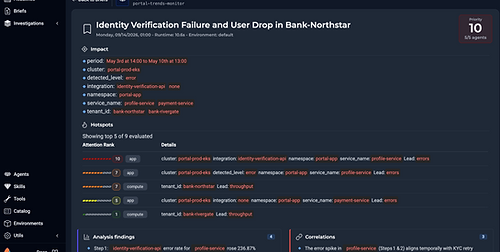
Proactive, adaptive, volatility-driven updates built by AI inference. Fueled by algorithms scouring copious production and DevOps data. Thoughtfully and intelligently delivered to Slack and other systems via schedules and/or triggers. Spots dynamic volatility. Offers actionable hypotheses and recommendations along with consolidated supporting evidence (storybooks, charts, graphs, etc.). All in one place. Autoptic Briefs equip you to become aware of, and remediate, potential problems brewing before they escalate into production incidents (brownouts, latency, overages, etc.).
Investigations: Explore & Understand
Reactive, always available, and prompt-based. AI-enabled telemetry exploration with natural language Q&A. Human and/or event driven. Ask questions across data Sources (logs, metrics, events, issues, patterns, etc.). Receive AI narrations coupled with charts, graphs, and tables, fueled by precise Tools, delivered quickly via the power of Autoptic PQL. With access for your entire engineering team (with no variable costs on people, data, tokens, or investigation themselves), Investigations enable on-the-fly democratized forensics—when you need rapid, detailed insights most.
Risks: Model & Simulate
While Briefs proactively notify you and Investigations reactively inform you, Risks equip you to understand long term trends. Going forward, Risks will help you predictively model potential and latent risk scenarios that can increase or decrease the possibilities of downstream production problems. Autoptic Risks enable you to make decisions about software engineering resources, vendors, configurations, processes, systems, infrastructure, services, and more. As systems change velocity accelerates, Autoptic Risks empower you to operate with confidence, knowing you are making wise choices that are aligned with the stability and performance appetite of your business.
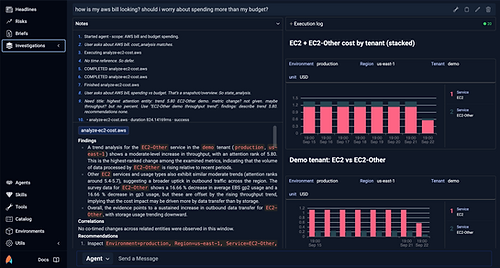
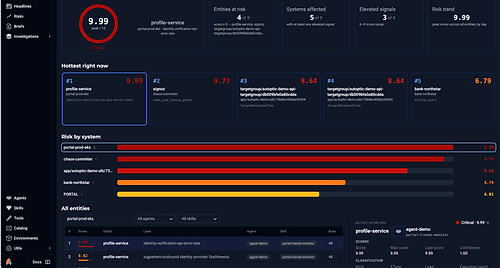
Autoptic Dynamic Dashboard Examples


Core Capabilities
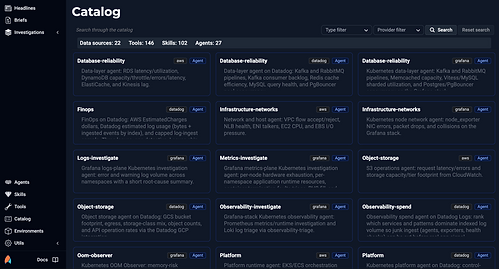
Supporting the Primary Experiences above, Autoptic Core Capabilities are managed by your Platform Engineering, DevOps, and/or SRE team (or by Autoptic Services personnel and/or Partners). These drive value, efficiently, for your entire software engineering organization. All are extensively covered in Autoptic Docs and enabled via the Autoptic Catalog.

Agents (25+)
Autoptic Agents power Briefs and Investigations. They use a combination of Skills, Tools, prompts, and more, harnessed via Orchestration, and invoking multiple AI models (both OSS and commercial LLMs). Today, Autoptic ships with 10+ Agents to deliver out of the box customer Solutions to common technology, data, and business scenarios. Autoptic is expanding our Agent Catalog based on customer demand and in partnership with our expert network. The software also enables customers and partners to create, expand, and modify Agents directly.
Skills (100+)
Autoptic Skills are specific tasks that bridge Tools and Agents, ensuring predictable pathways that automate and align with the core jobs that DevOps engineers, SREs, platform engineers, and other EngOps leaders perform regularly. Skills include workflows (orchestrated for predictable execution) and Detective pathways (agentic AI for exploration). Today, Autoptic ships with 30+ Skills, available via the Catalog. Like Agents and Tools, Skills are buildable and modifiable by customers and partners.
Tools (150+)
Autoptic Tools provide packaged, deterministic, computational algorithms that operate across Sources to enable Agents and Skills. Today, Autoptic offers 40+ pre-built and reusable Tools, leveraging our proprietary and efficient domain specific language (DSL), Autoptic PQL (which is generally used via coding tools like Claude). Additional Tools are under constant development based on market and customer needs. Like Agents and Skills, you can also create, edit, and manage your own Tools in the Autoptic platform.
Sources (20+)
Autoptic Sources collect information via a unique approach to federated search. Autoptic enables data, event, and trend (telemetry) aggregation from third party observability, issue management, change management, repository, CI/CD, monitoring, metrics, analytics, and other DevOps system types. Today, Autoptic has pre-built, bespoke API access to 15+ Sources, including AWS, Datadog, GitHub, GitLab, Grafana, JIRA, OpenSearch, and Prometheus. Autoptic also provides a universal MCP agent, allowing enhanced context between Autoptic and external MCP-enabled systems. More Sources are under development and become available based on customer and market needs.
Operating Autoptic
Autoptic Primary Experiences and Core Capabilities are layers in a robust software system that is either hosted by Autoptic or deployed into your Virtual Private Cloud (VPC) via a BYOC (Bring Your Own Cloud) model. Installation and updates are assisted by Autoptic FDE resources and delivered via the Autoptic Helm chart (for Kubernetes), Docker containers, or other approaches. The Autoptic conceptual architecture is below:

Enabling Features
Autoptic Enabling Features are engines that power the Capabilities and Experiences outlined above. They include:
-
Agent Orchestration: is a flexible harness that enables teams to centralize and manage intelligent AI Agents, Skills, and Tools across their environments and cross-system workflows.
-
Change Detection: identifies anomalies across high-cardinality telemetry, correlating co-spikes, scoring attention, and surfacing findings across complex, often multi-tenant services.
-
Deterministic Analytics: constructs consistent charts, graphs, tables, and calculations rapidly. Powered by Performance Query Language (PQL), an intuitive, efficient DSL for describing and executing workflows. Built for trainability, verity, and efficiency. Understandable and manageable by Claude and other AI coding tools.
-
Dynamic Outliers: surfaces meaningful signals of volatility within complex telemetry. Rather than relying on static thresholds, Autoptic combines relative scale with evidence of recent changes, separates localized spikes from fleet-aligned movements, and pairs notable shifts with baseline context.
-
Federated Search: accesses, aggregates and distills telemetry. Retains only essential logs, traces, metrics, and events versus storing extensive volumes of raw data. With recurring snapshots and selective retention of insights, avoids expensive storage and processing costs.
-
Environment Discovery (Coming Soon): automatic system sensing where Autoptic discovers the shape of the environment, the services running, the signals available, and the relationships between them. Discovery will enable self-configuring options with minimal manual setup.
-
Change Ledger (Coming Soon): builds a living memory of your systems by recording important, impactful changes (planned or unplanned, internal and external), providing the foundation to model, predict, and assess latent and future system risk.
Key Technologies
Autoptic Key Technologies are used across Enabling Features. They are under the hood elements of what makes Autoptic operate in real-world, fast-moving, complex, large-dataset environments. Many of these Technologies contain more than two years of core software development behind them. In a world of agentic AI promises, we offer that these Technologies are part and parcel of what’s needed to operate a robust approach to DevOps Change Resilience.
-
Compression: Autoptic's data management approach preserves only the most relevant insights. Data is gathered, normalized, and aggregated in real-time, in memory, minimizing resources and storage requirements.
-
Catalog: a curated library of ready-to-use Agents, Skills, and Tools for the Autoptic system. Instead of building capabilities from scratch, customer teams pick the foundational elements they want, contextualize them on the fly, attach them to how the team works, and then update them as needed.
-
Scheduling: provides cron job management, task scheduling and execution, dependency resolution, retry logic and error handling, execution monitoring, etc.
-
Notification: coordinates delivery of results produced by an Autoptic Agent to a destination (e.g., Slack, email, webhook). Often guided by intelligent volatility analysis.
-
Deployment: manages binaries and language model updates in a BYOC/VPC environment, enabling Autoptic customers to control techniques like Docker Hub compose pulls.
-
Model: Autoptic provides an embedded and managed LLM (hosted or deployed into your cloud environment). At the same time, Autoptic offers an open architecture that enables multiple model usage—including your commercial or OSS choice(s).
Control Planes
Autoptic Control Planes manage how resources, data flows, permissions, and compute behaviors are configured, orchestrated, and updated over time. They act as the layer of logic and policy that directs Autoptic system state.
-
Integrations: the Autoptic open architecture equips API-level access and automation to key features, technologies, and capabilities.
-
Infrastructure: governs how compute, storage, and network resources are optimized for Autoptic environments, whether hosted by Autoptic or managed by our customers (in a BYOC/VPC model).
-
Data: defines how telemetry, logs, metrics, and events are collected, routed, transformed, and retained. Autoptic brings structure to this layer by unifying fragmented pipelines into a coherent “change-aware” system.
-
Tokens: manages how AI and automation consume, allocate, and optimize tokens across models, agents, and workflows. Helps customers prevent runaway costs and ensure inference remains aligned with operational intent.
-
Access: controls who and what can act across systems, APIs, and automation layers. Leverages SSO and cloud management.
Explore Autoptic Further
Visit Autoptic Solutions to learn more about the impacts and use cases of Autoptic. See Autoptic Services for details on offerings to help you on your change resilience journey. Visit About Us and Why Autoptic? to gain insights on the company behind Autoptic software.